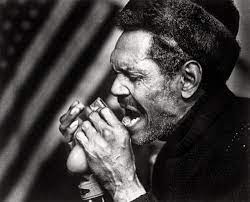
Big Walter Horton – A Complete Biography
Introduction
Walter “Big Walter” Horton stands among the most influential harmonica players in American blues. Renowned for a warm, powerful tone, a deceptively simple phrasing that concealed great subtlety, and an uncanny feel for rhythm and space, Horton shaped the modern blues harp vocabulary used by generations of players. Quiet and somewhat reclusive in disposition, he nonetheless left an outsized musical footprint through recordings, club appearances, collaborations with major Chicago blues figures, and a reputation among peers as one of the foremost harmonica soloists of the 20th century.
Childhood
Walter Horton was born in Horn Lake, Mississippi, and raised in Memphis after his family moved north across the state line. Family circumstances were modest; like many Black children growing up in the Jim Crow South, Horton experienced the economic hardships and limited opportunities typical of the era. He discovered the harmonica at a very young age and taught himself to play, practicing constantly and absorbing the sounds of street musicians and jug-band players he heard in Memphis.
From his earliest years Horton showed a precocious talent. He learned by watching and playing alongside older musicians and local innovators — absorbing techniques such as tongue-blocking and playing cross-harp that would later define his sound. The Memphis musical environment of the 1920s and 1930s — a mixture of country blues, jug-band music, and the beginnings of urban electric blues — provided Horton with an informal but rich apprenticeship.
Youth
As a youth Horton began performing more regularly. He worked with local groups and played on street corners, absorbing the repertory and the language of the blues harp. He also came into contact with influential regional players who shaped his technique, and he developed a reputation for a strong, full-bodied tone and a measured, lyrical approach to soloing.
By the late 1930s and into the 1940s Horton had begun to play professionally. His early career was typical of many itinerant bluesmen of the period: gigs in juke joints, occasional recording opportunities, and movement between cities in search of steady work. Horton’s playing started to attract attention from fellow musicians for its expressive clarity — the ability to deliver raw emotion while maintaining precise control over phrasing and dynamics.
Adulthood
Horton eventually became an important figure on the Chicago and Memphis blues scenes. He relocated to the North (Chicago became his long-term base), where a thriving postwar urban blues culture welcomed electrified instruments and new audiences. Horton’s harp adapted well to the amplified settings of Chicago clubs; he combined the intimacy of acoustic blues phrasing with the projection needed for electric bands.
Across the 1950s through the 1970s Horton recorded with numerous artists and issued records under his own name. Though he was not always a prolific recording artist compared with some peers, the quality of his recorded work was consistently high — and his contributions as a sideman were widely prized. Horton worked with significant figures in the blues world, including Muddy Waters and Johnny Shines, and he often sat in with Willie Dixon’s ensembles and other major Chicago acts.
Throughout his adult life Horton was known to be shy, modest, and given to storytelling; he could be plainspoken and unassuming offstage, while onstage his harmonica could be commanding and free. He steadily acquired a reputation among musicians as a musician’s musician: admired by peers such as Willie Dixon and emulated by aspiring harp players around the world.
Major compositions and recordings
Horton’s reputation rests as much on his recorded performances and on the phrasing and techniques he modeled as on conventional “compositions.” He is perhaps better known for classic recordings and memorable solos than for a catalogue of original tunes that became standards in their own right. Notable recordings and sessions that capture his artistry include early sides and LPs dating from the 1950s through the 1970s, as well as session work where his harp provides defining color and counterpoint to the leader’s material.
Two albums that are frequently cited when assessing his legacy are The Soul of Blues Harmonica (an early showcase of his harp work) and later collaborative records such as Big Walter Horton with Carey Bell (which captured him playing with a younger harp player and demonstrated his continuing vitality in the studio). Horton also played on sessions and albums for other major artists; his presence on records by Muddy Waters and other Chicago figures helped cement his place in the electric blues canon. Beyond studio recordings, his live performances at Maxwell Street and at blues festivals exposed his art to devotees and newcomers alike.
Musically, Horton’s hallmarks included a warm, round tone, expert use of tongue-blocking, expressive bends and vibrato, economical but profound phrasing, and a facility for both supporting band arrangements and stepping into intense, vocal-like harp solos. These elements — less a catalogue of specific melodies than a set of stylistic contributions — are among his most significant creative legacies.
Death
Walter Horton’s later life was marked by ongoing performing and recording, but also by personal difficulties. He continued to work into the late 1970s, appearing at festivals and on club bills, and he made his last recordings around 1980. Horton died in Chicago on December 8, 1981. The circumstances of his death included heart failure; some official records and accounts also cite complications related to alcoholism. He was buried at Restvale Cemetery in the Chicago area.
Following his death, the blues community recognized Horton’s lifetime contributions: he was inducted posthumously into the Blues Hall of Fame, and markers and tributes have commemorated his influence in the Mississippi region where he was born as well as in Chicago where he worked for decades.
Conclusion
Big Walter Horton occupies an essential place in the history of blues harmonica. More than a virtuoso known for flashy technique, he exemplified economy of phrase, tonal beauty, and a capacity to serve song and ensemble while delivering moments of singular expression. His influence is evident in the playing of later generations and in the harmonic vocabulary of blues harp generally; students of the instrument still study his recordings for lessons in tone, timing, and the art of saying much with little.
Although his life included hardships and times of obscurity, Horton’s recorded work and the testimony of fellow musicians preserved his reputation. For anyone tracing the development of modern blues harp — from the acoustic juke-joint phrasing of the Delta and Memphis to the amplified urban Chicago sound — Big Walter Horton is an indispensable figure whose music continues to instruct and inspire.
Comments are closed