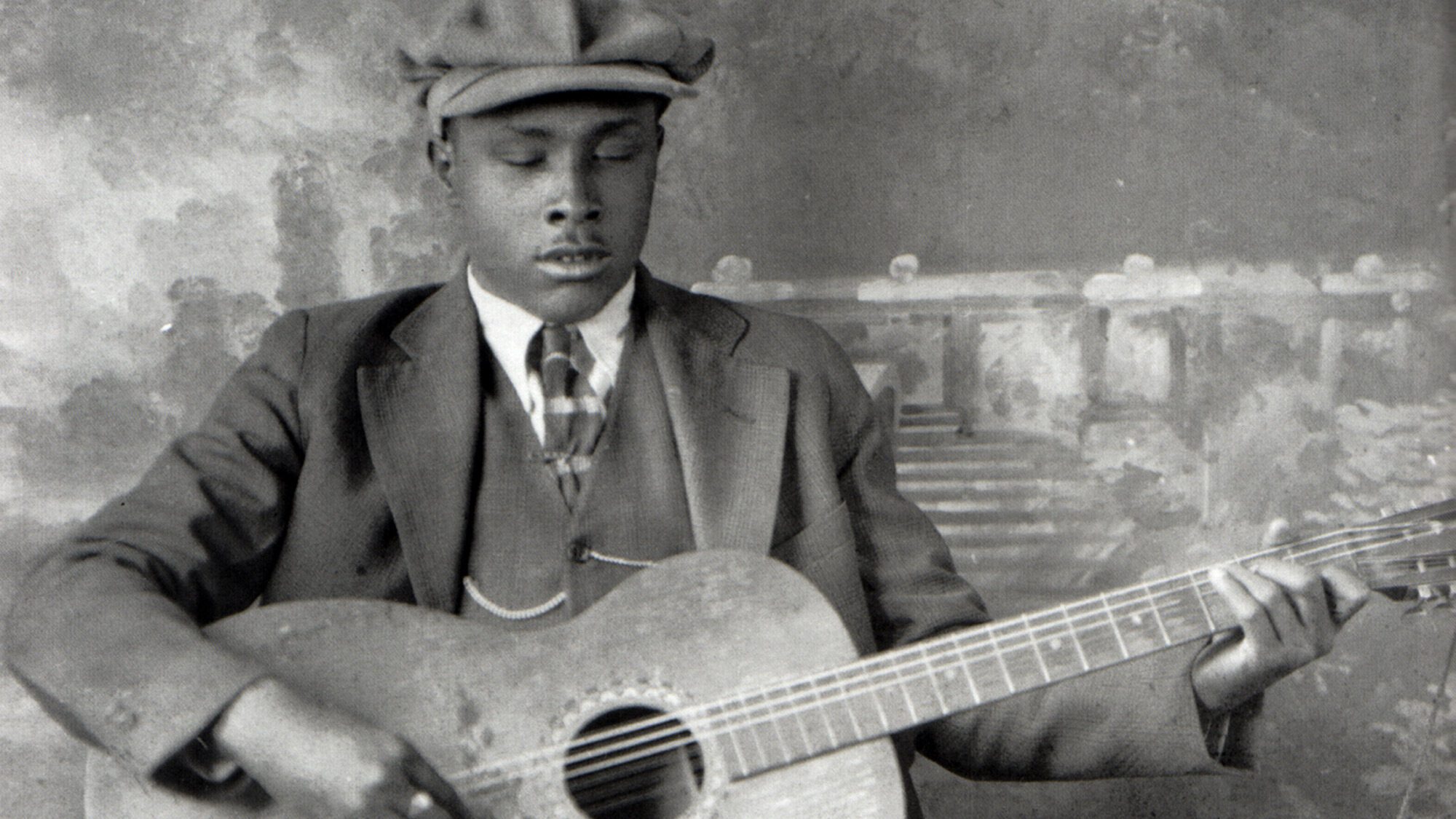
Blind Willie McTell – A Complete Biography
Introduction
William Samuel McTier, known professionally as Blind Willie McTell, stands as one of the most distinctive and influential practitioners of East-Coast/Piedmont blues and ragtime guitar in American music. Though he never achieved commercial stardom in his lifetime, McTell’s fluid fingerpicking, frequent use of the twelve-string guitar, repertoire that mixed secular blues, ragtime, gospel, and hokum, and a singing tenor that contrasted with the rougher Delta voices, secured him a lasting legacy among musicians and scholars. This biography reconstructs McTell’s life and work through his formative years, professional development, principal compositions, final years and death, and his posthumous influence.
Childhood
William Samuel McTier was born in Thomson, Georgia, in the final years of the nineteenth century. Family and local records offer slight discrepancies in the exact birth year—some memorials record 1901 while several authoritative sources favor 1898—but all accounts place his origin in McDuffie County, Georgia, and identify a close family environment steeped in music. Blind in one eye from birth and then losing his remaining sight during childhood, McTell’s formal education included attendance at schools for blind children, where he learned braille and developed early musical skills.
Music was a familial craft: his mother and other relatives played and sang, exposing him to a variety of vernacular styles. McTell first played harmonica and accordion, later concentrating on the guitar in his early teens. His early environment—rural Georgia towns such as Thomson and Statesboro—allowed him to absorb a mixture of secular and sacred material, and to practice in public settings. The combination of formal instruction (in the schools for the blind) and practical, community-based apprenticeship prepared him for a life as a traveling songster.
Youth
In his adolescence and young adulthood McTell became an itinerant performer. He traveled regionally, performing on streets, at parties, and with medicine shows and traveling entertainments that circulated across the American South in the 1910s and 1920s. These experiences honed his ability to engage diverse audiences and to shift smoothly among musical idioms—gospel, blues, ragtime, and comic or “hokum” songs—making him a prototypical songster rather than a narrowly specialized bluesman.
During these years he developed the two characteristics that define his recorded legacy: a percussive, syncopated fingerpicking style (frequently on a twelve-string guitar) and the use of slide technique in contexts where slide was not common. The twelve-string’s greater volume and fuller harmonic texture suited the outdoor settings in which McTell often worked; his choice of instrument and approach to accompaniment are central to assessments of his musicianship.
Adulthood and Recording Career
McTell’s recording career began in the late 1920s. He cut his earliest sides for major commercial labels during the acoustic and early electrical recording era, first recording for Victor in 1927 and then for other companies across the 1920s and 1930s under various names and sometimes with accompanists. Over repeated sessions he recorded a large and varied body of work—country blues, ragtime instrumentals, religious songs, and humorous numbers—often self-accompanying on twelve-string guitar.
Throughout the 1930s and into the 1940s McTell continued to perform across Georgia and neighboring states, at times collaborating with other Atlanta area musicians. He recorded under multiple monikers and with different labels, reflecting the era’s marketplace and the common practice among Black recording artists of the period. Although he never achieved a major hit on the national charts, he made over a hundred recordings during his career, many of which circulated on 78 rpm records and later on compilation reissues.
In the 1940s and 1950s McTell’s public profile shifted toward more local and informal engagements: street performances, rent parties, fish fries, and religious services. He was known to perform with long-time friends and peers from the Atlanta blues scene. Late in life he recorded again in ad-hoc sessions—sometimes captured by local record store owners or folklorists—keeping his voice and guitar present even as popular tastes changed.
Major Compositions
Blind Willie McTell’s recorded repertoire is large and diverse; several pieces, however, have become emblematic of his craft and endured in the repertoires of later artists.
- “Statesboro Blues.” Perhaps his best known song, “Statesboro Blues” showcases McTell’s twelve-string technique and his blend of narrative lyric and driving, syncopated accompaniment. First recorded in the late 1920s, it later achieved broader recognition through covers and reinterpretations—most famously by Taj Mahal and the Allman Brothers Band—becoming a standard of American roots and rock repertoires.
- “Broke Down Engine Blues” and similar travel/railroad songs. McTell recorded a number of songs that used travel metaphors and railroad imagery, reflecting a common blues subject and the mobility that characterized many itinerant performers’ lives.
- Religious and spiritual recordings. McTell’s gospel repertoire—rendered with the same technical fluency he applied to secular tunes—demonstrates his versatility. Spiritual recordings such as “I Got to Cross the River Jordan” show the continuity between sacred and secular in his performing life.
- Ragtime-inflected instrumentals and hokum pieces. McTell blended ragtime guitar patterns and lighthearted hokum lyrics in several recordings, demonstrating his role as a songster who could entertain across contexts.
Across his catalog, McTell is notable for the musical variety and the technical command of fingerpicking and slide—characteristics that influenced subsequent generations of acoustic and electric guitarists.
Death
In the final years of his life McTell experienced health problems. Accounts indicate he lived with diabetes and struggled with alcoholism. In August 1959 he was admitted to a state hospital in Milledgeville, Georgia, where he died on August 19, 1959. Reports attribute his death to a cerebral hemorrhage (stroke). His burial took place near his birthplace; decades later friends and researchers arranged for a more prominent marker recognizing his contribution to American music.
Conclusion and Legacy
Blind Willie McTell’s life exemplifies a musician whose technical gifts and broad repertoire outstripped the commercial recognition available to many African-American artists of his generation. His approach to the twelve-string guitar, his smooth tenor, his adaptability across sacred and secular repertoires, and his recorded legacy—made under difficult economic and social constraints—secured him an enduring place in the history of American roots music.
After his death, McTell’s reputation grew steadily. The folk and blues revivals of the 1960s and 1970s, and prominent covers of his material by rock and roots artists, introduced his work to new audiences. Musical scholars and collectors reissued his recordings; historians recognized him in halls of fame and scholarly literature; and contemporary guitarists cite him as an important predecessor in fingerstyle and twelve-string technique. His life story—an itinerant, technically inventive songster who bridged gospel, ragtime, and blues—remains an essential chapter in the larger narrative of twentieth-century American music.
Comments are closed