Introduction
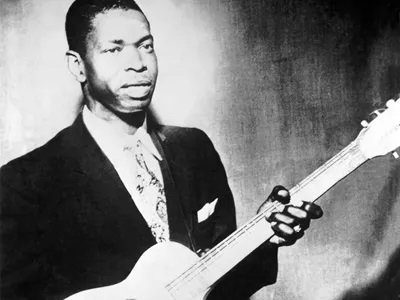
Elmore James was one of the most influential figures in the history of the blues. Known as the “King of the Slide Guitar,” he transformed traditional Delta blues into a powerful electric style that helped shape modern blues and rock music. His intense vocals, innovative guitar techniques, and emotionally charged performances made him a pioneering artist whose influence extended far beyond his lifetime. Though his career lasted little more than a decade, his recordings inspired generations of musicians, including Eric Clapton, Duane Allman, Jimi Hendrix, Brian Jones, and countless others.
Born into poverty in rural Mississippi, James rose from humble beginnings to become one of the defining voices of postwar American blues. His signature sound, particularly the opening guitar riff of “Dust My Broom,” remains one of the most recognizable passages in blues history.

Childhood
Elmore James was born Elmore Brooks on January 27, 1918, in Richland, Mississippi. He was raised by his mother, Leola Brooks, and later took the surname of his stepfather, Joe Willie “Frost” James. His childhood was spent in the Mississippi Delta, one of the most culturally significant regions in the development of the blues.
Like many African American families in the South during the early twentieth century, the James family worked as sharecroppers. Life was difficult, and educational opportunities were limited. Nevertheless, young Elmore developed an early fascination with music. As a child, he built and played a simple one-string instrument known as a diddley bow, often fashioned from wire stretched across a wall or wooden board.
These early experiments helped him develop a remarkable ear for pitch and tone. By the time he acquired a guitar, he had already become skilled at creating expressive sounds and musical phrases. Music soon became both a passion and a means of escaping the hardships of rural life.
Youth
During his teenage years, James began performing at local dances, juke joints, and social gatherings throughout Mississippi. He earned a reputation as a talented guitarist and singer while also working various jobs, including repairing radios.
One of the most important developments of his youth was his exposure to the music of Robert Johnson, whose recordings profoundly influenced him. According to many accounts, James may have met Johnson during the late 1930s. Whether as a direct student or an admirer, James absorbed Johnson’s slide guitar techniques and adapted them into his own distinctive style.
He also developed close professional relationships with other blues musicians, including Sonny Boy Williamson II. Through these collaborations, James became increasingly active in the Mississippi blues scene and refined the sound that would later make him famous.
During World War II, James served in the United States Navy. His military service interrupted his musical activities but provided valuable life experience. After the war, he returned to Mississippi determined to pursue music more seriously.
Adulthood
The turning point in Elmore James’s career came in 1951 when he recorded “Dust My Broom,” an adaptation of Robert Johnson’s earlier song “I Believe I’ll Dust My Broom.” The recording featured a powerful electric slide guitar introduction that immediately distinguished James from other blues performers. Released by Trumpet Records, the song became a major rhythm-and-blues hit and established him as a rising star.
Following the success of “Dust My Broom,” James assembled a backing group known as the Broomdusters. Throughout the 1950s, he recorded for several labels, including Flair, Meteor, Modern, Chess, Chief, and Fire Records. His recordings consistently showcased his trademark combination of passionate vocals and aggressive slide guitar work.
Unlike many blues artists of his era, James embraced amplification as an essential part of his sound. His guitar tone was loud, raw, and emotionally intense. This approach bridged the gap between traditional Delta blues and the urban electric blues emerging in Chicago.
During the late 1950s and early 1960s, he recorded some of his finest material, including “The Sky Is Crying,” “Shake Your Moneymaker,” “Look on Yonder Wall,” “Done Somebody Wrong,” and “Stranger Blues.” These songs became blues standards and were later recorded by numerous rock and blues artists.
Despite his growing reputation, James struggled with health problems and the financial instability that affected many blues musicians of his generation. Nevertheless, he continued performing and recording until the end of his life.
Major Compositions
Dust My Broom (1951)
This song is widely regarded as Elmore James’s signature recording. Its unforgettable slide guitar introduction became one of the most influential guitar riffs in blues history. The recording helped define the sound of electric blues and remains a foundational work in American music.
I Believe
Released shortly after “Dust My Broom,” this recording became another successful rhythm-and-blues hit. It demonstrated James’s ability to combine emotional singing with powerful guitar accompaniment.
The Sky Is Crying
Recorded in 1959 and released in 1960, this slow blues masterpiece is considered one of James’s greatest achievements. The song’s emotional depth and expressive slide guitar work have made it a permanent part of the blues canon.
Shake Your Moneymaker
This energetic blues number became one of James’s most enduring songs. Decades later, it would be covered by numerous artists and remain a staple of blues and rock performances.
Done Somebody Wrong
A classic example of James’s mature style, this song blended strong vocal delivery with memorable guitar lines. It later gained new audiences through interpretations by rock musicians.
Look on Yonder Wall
Known for its driving rhythm and distinctive guitar work, this recording further demonstrated James’s ability to combine traditional blues themes with modern electric instrumentation.
It Hurts Me Too
Although based on earlier blues traditions, James’s version became one of the most celebrated interpretations of the song. Its emotional sincerity and expressive guitar playing made it a favorite among later blues performers.
Death
For several years, Elmore James suffered from heart problems. Despite warnings from doctors, he maintained a demanding schedule of performances and recording sessions.
On May 24, 1963, he died of a heart attack in Chicago, Illinois, at the age of forty-five. His death came just as international interest in American blues was beginning to grow rapidly. He had been preparing to participate in the American Folk Blues Festival in Europe, an opportunity that might have introduced him to an even wider audience.
James was buried in Mississippi. In the years following his death, recognition of his achievements continued to expand. He was inducted into the Blues Hall of Fame in 1980 and the Rock and Roll Hall of Fame in 1992 as an Early Influence.
Conclusion
Elmore James occupies a unique position in American musical history. He served as a bridge between the acoustic Delta blues of the prewar era and the electrified blues that flourished after World War II. His mastery of slide guitar, emotional vocal style, and innovative use of amplification helped create a new sound that would influence both blues and rock music for decades.
Although his life was relatively short, his artistic legacy remains enormous. Songs such as “Dust My Broom,” “The Sky Is Crying,” and “Shake Your Moneymaker” continue to be performed, recorded, and studied by musicians around the world. Today, Elmore James is remembered not only as one of the greatest blues artists of all time but also as a foundational architect of modern guitar music.
Comments are closed