
Ornette Coleman – A Complete Biography
Introduction
Ornette Coleman (1930–2015) was an American jazz saxophonist, trumpeter, violinist, and composer whose improvisational language drew deeply on the Texas blues and rhythm-and-blues traditions while transforming modern jazz. Beginning in the late 1950s, he became a principal founder of free jazz, advancing a theory he called “harmolodics” that loosened dependence on fixed chord changes and prioritized melody, timbre, and collective interplay. His landmark albums, controversial club residencies, and later orchestral and electric projects reshaped how improvisers conceive structure and expression across genres.
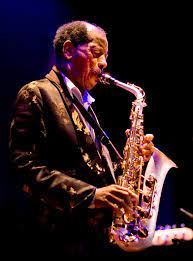
Childhood
Randolph Denard Ornette Coleman was born on March 9, 1930, in Fort Worth, Texas. His mother bought him an alto saxophone when he was 14, and he began teaching himself to play. At I.M. Terrell High School he joined the band but was dismissed for improvising rather than following written parts, an early sign of his urge to play ideas beyond conventional rules. His formative environment included church music, blues phrasing, and local R&B bands, all of which informed his tone and melodic sensibility throughout life.
Youth
Eager to work as a professional musician, Coleman joined traveling shows, including Silas Green from New Orleans. After a gig in Baton Rouge where his tenor saxophone was destroyed in an assault, he switched to alto saxophone, which remained his primary instrument. He moved to Los Angeles in the early 1950s, supported himself with day jobs such as elevator operator, and studied harmony and musical theory on his own. In LA he connected with like-minded players—Don Cherry, Charlie Haden, Billy Higgins, and later Ed Blackwell—who were open to his unconventional concepts. His first albums, “Something Else!!!!” (1958) and “Tomorrow Is the Question!” (1959), recorded for Contemporary Records, began presenting a piano-less ensemble approach that emphasized melodic freedom over standard chordal grids.
Adulthood
Coleman’s breakthrough came in New York in 1959, when his quartet’s residency at the Five Spot Cafe stirred heated debate and admiration. That same year he released “The Shape of Jazz to Come” on Atlantic Records, followed by “Change of the Century” (1960), “Free Jazz: A Collective Improvisation” (1960), “This Is Our Music” (1960), and “Ornette!” (1961). These recordings foregrounded collective improvisation, elastic rhythm, and melodies steeped in blues phrasing, while sidestepping fixed chord progressions. Though some contemporaries castigated him, figures like Leonard Bernstein and a growing cohort of critics recognized his importance, and his sound soon influenced ensembles across the US and Europe.
In later decades, Coleman broadened his palette. He explored orchestral writing with “Skies of America” (1972), recorded with the London Symphony Orchestra, and delved into amplified, groove-centric textures with his electric band Prime Time, articulating harmolodics through layered guitars and polyrhythms. He collaborated widely, notably with Pat Metheny on “Song X” (1986), and engaged global traditions, including work with the Master Musicians of Joujouka in North Africa. Coleman’s work remained grounded in blues feeling even as it challenged established hierarchies of harmony, melody, and rhythm.
Recognition followed his persistence. He received Guggenheim support, the MacArthur Fellowship (1994), the Gish Prize (2004), and, for the live album “Sound Grammar” (2006), the Pulitzer Prize for Music in 2007—the first Pulitzer-winning recording of purely improvised music. He was also honored with a Grammy Lifetime Achievement Award. Across seven decades, he maintained a distinct voice: piercing, vocal-like alto lines; occasional trumpet and violin; and an insistence that musical equality—between players, ideas, and sounds—was both possible and urgent.
Major Compositions
- Lonely Woman: An emotive, blues-tinged theme from “The Shape of Jazz to Come” (1959) that became a jazz standard and emblem of Coleman’s lyrical, free approach.
- Broadway Blues: A compact piece that encapsulates his blend of blues vocabulary with harmolodic freedom; widely performed and taught.
- The Shape of Jazz to Come (album): A watershed recording that announced his quartet’s piano-less concept and reoriented jazz improvisation around melody and ensemble interplay.
- Free Jazz: A Collective Improvisation (album): A double-quartet session recorded as a continuous collective improvisation, a landmark in avant-garde ensemble practice.
- Skies of America (orchestral work): A large-scale symphonic project recorded with the London Symphony Orchestra, integrating Coleman’s themes with orchestral textures.
- Song X (with Pat Metheny): A high-energy collaboration that connected harmolodic ideas with fusion-era guitar expression.
- Dancing in Your Head / Prime Time repertoire: Electric, rhythm-forward albums that tested harmolodics in layered, amplified settings.
- Sound Grammar: Live quartet music with two basses highlighting Coleman’s late-career clarity; awarded the 2007 Pulitzer Prize for Music.
Death
Ornette Coleman died of cardiac arrest in Manhattan, New York, on June 11, 2015, at age 85. Obituaries in major newspapers emphasized both the controversy that surrounded his early breakthroughs and the enduring impact of his music on generations of improvisers, composers, and listeners worldwide.
Conclusion
Coleman’s biography reads as a story of devotion to sound and its human possibilities. From his Texas youth through his New York breakthroughs, he insisted that players could converse freely without the strictures of chord changes, and that the blues—its contours, cries, and cadences—could animate any modern language. Harmolodics sought a democratic music in which melody, harmony, and rhythm could coexist with equal authority, and musicians could realize their ideas without hierarchical constraint. His body of work—quartet records, orchestral experiments, electric harmolodics, and late-career masterworks—continues to influence jazz, classical composition, experimental rock, and beyond. He changed how players listen and respond; he changed how composers conceive structure; he changed how audiences understand freedom in music.
Comments are closed