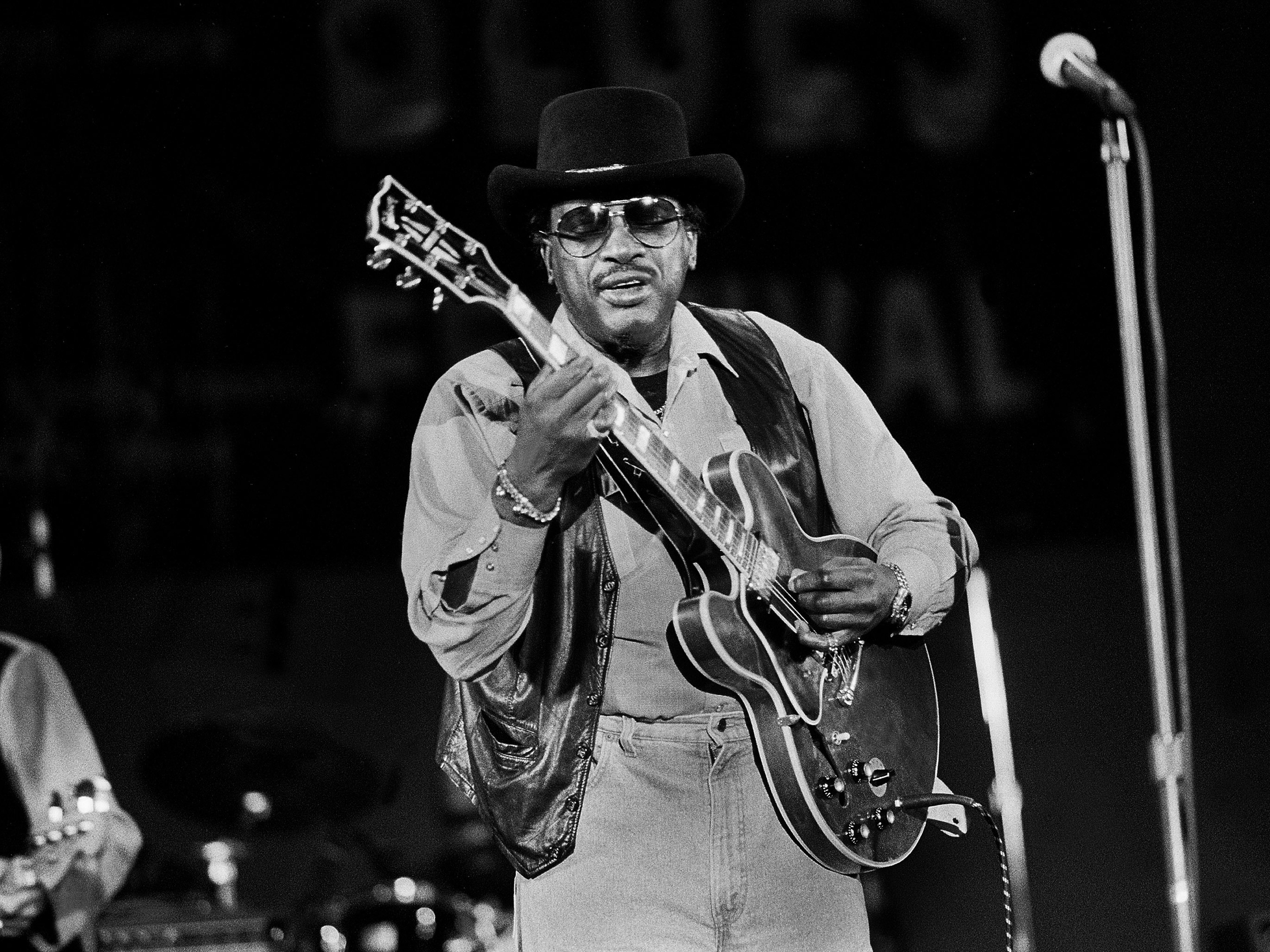
Otis Rush – A Complete Biography
INTRODUCTION
Otis Rush Jr. (April 29, 1934 – September 29, 2018) was an American blues guitarist and singer-songwriter, widely recognized as one of the architects of the “West Side Chicago blues” sound. His distinctive guitar style, characterized by a slow-burning sound and long bent notes, along with his powerful, wide-ranging tenor voice, influenced countless musicians, including Eric Clapton, Stevie Ray Vaughan, and Peter Green. Rush revolutionized the genre with his passionate performances and unique sound, playing a left-handed guitar strung upside down, which many believe contributed to his peculiar tone.

CHILDHOOD
Born near Philadelphia, Mississippi, in 1934, during the Great Depression, Otis Rush was the son of sharecroppers, Julia Campbell Boyd and Otis C. Rush. He was the sixth of seven children and worked on the farm throughout his childhood, often being pulled out of school by his mother to help supplement the family income. Music served as his solace from an early age; he sang in gospel choirs and taught himself to play guitar and harmonica, performing on street corners. Rush described Neshoba County, Mississippi, as the place where his soul and faith began.
YOUTH
Determined not to spend his life in the cotton fields, Rush moved north to Chicago in 1949 at the age of 14. In the city, he worked in stockyards, steel mills, and drove a horse-drawn coal wagon, while spending his nights in the city’s blues clubs. It was in Chicago that he was inspired by Muddy Waters, which led him to dedicate himself to music and make a name for himself in the blues clubs on the South and West Sides of the city, initially using the name “Little Otis.”
ADULTHOOD AND CAREER
Otis Rush’s career took off when Willie Dixon signed him to Cobra Records, a local independent label. Between 1956 and 1958, with Dixon producing, Cobra recorded and released eight tracks that made him famous, including “Double Trouble,” “All Your Love (I Miss Loving),” and “I Can’t Quit You Baby.” His first single, “I Can’t Quit You Baby,” was a national hit in 1956, reaching number six on the Billboard R&B chart.
After Cobra’s bankruptcy in 1959, Rush signed with Chess Records in 1960, where he recorded eight tracks, though only four were initially released. He later signed with Duke Records, but that partnership also resulted in few recordings. In the 1960s, Rush began playing in other cities in the United States and Europe, participating in tours like the American Folk Blues Festival. In 1969, Cotillion Records released his first full album, “Mourning in the Morning,” which incorporated elements of soul and rock.
Throughout the 1970s and 1980s, Rush continued to tour the world but was shamefully under-recorded. In 1971, he recorded “Right Place, Wrong Time” for Capitol Records, but the album remained unreleased for five years before being released by smaller labels. He made a notable comeback in 1985 with a U.S. tour and the release of a live album, “Tops.” In 1994, “Ain’t Enough Comin’ In” was his first studio album in 16 years, and in 1998, “Any Place I’m Going” earned him a Grammy Award for Best Traditional Blues Album. Despite his popularity, Rush turned down significant opportunities, such as recording and touring with the Rolling Stones.
MAJOR COMPOSITIONS
Otis Rush is remembered for a series of compositions that defined the blues genre and influenced generations. Among his most notable works are:
- “I Can’t Quit You Baby” (1956): His first major hit, which reached the Top 10 of the R&B charts.
- “Double Trouble” (1958): A minor-key masterpiece that became one of his most iconic songs.
- “All Your Love (I Miss Loving)” (1958): Another seminal track from the Cobra Records era.
- “So Many Roads, So Many Trains” (1960): A classic recorded for Chess Records, known for its emotional intensity.
- “Homework” (1962): Released by Duke Records, it demonstrated his versatility.
- “Mourning in the Morning” (1969): His first full album, which explored fusions with soul and rock.
- “Right Place, Wrong Time” (1971): Considered by many to be one of his best works, although it had a delayed release.
- “Ain’t Enough Comin’ In” (1994): Marked his return to the studio and was critically acclaimed.
- “Any Place I’m Going” (1998): Grammy-winning album, solidifying his legacy.
DEATH
Otis Rush passed away on September 29, 2018, at the age of 84, from complications of a stroke he had suffered in 2003. His death was announced by his wife, Masaki, on his official website. A celebration in his honor was held on April 24, 2019, in Evanston, Illinois.
CONCLUSION
Otis Rush left an indelible legacy in the history of the blues. His unique guitar skills, expressive voice, and ability to infuse deep emotion into every note established him as a legendary figure. He was inducted into the Blues Hall of Fame in 1984 and received a Lifetime Achievement Award from the Jazz Foundation of America in 2018. Rolling Stone magazine ranked him 53rd on its list of the 100 Greatest Guitarists. Gregg Parker, CEO of the Chicago Blues Museum, described him as “one of the last great blues guitar heroes” and “an electric god.” Otis Rush’s contribution to Chicago blues, especially the “West Side Sound,” continues to resonate and inspire musicians and fans worldwide.
Comments are closed