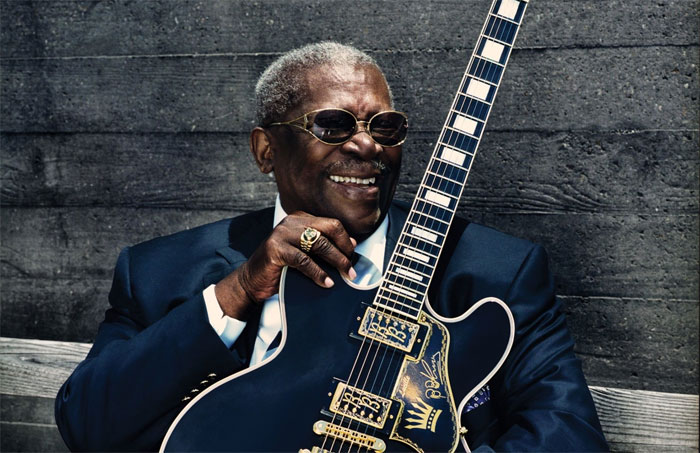
BB King – A Complete Biography
Introduction
Riley B. King, universally known as B.B. King, stands as one of the most influential figures in the history of American music. Revered as the “King of the Blues,” his singular guitar tone, expressive vibrato, and emotionally charged vocals reshaped the blues landscape and inspired generations of musicians across genres. Throughout a career spanning more than six decades, King became a global ambassador for the blues, performing thousands of concerts, recording a vast discography, and establishing an artistic legacy that endures as a foundational pillar of modern popular music.

Childhood
B.B. King was born Riley B. King on September 16, 1925, on a cotton plantation near Itta Bena, Mississippi. His early years were marked by the challenges common to African American families living in the segregated Deep South. His parents, sharecroppers Albert and Nora Ella King, separated when he was young, leaving Riley to be raised primarily by his mother and maternal grandmother.
Growing up in the Mississippi Delta, King was immersed in a world where music functioned both as entertainment and as a means of emotional expression. Church services—often the center of community life—were his earliest musical inspiration. He learned spirituals and gospel hymns in a local Pentecostal church, where he first encountered the guitar. By the time he was a teenager, King had developed a deep appreciation for both sacred and secular African American musical traditions, including the emerging Delta blues.
Youth
During his youth, King worked long hours as a farmhand while dreaming of life as a professional musician. His formative influences included Delta blues legends such as Bukka White, Robert Johnson, and Lonnie Johnson. A pivotal moment came when King moved to Indianola, Mississippi, where he began performing publicly at local venues and on street corners. These early performances taught him how to engage audiences and refine his increasingly distinctive guitar style.
In 1943 he was briefly employed as a tractor driver on a local plantation, but his passion for music continued to take priority. In 1946, King hitchhiked to Memphis, Tennessee—one of the South’s major musical hubs—to pursue professional opportunities. Although his first attempt yielded limited success, he returned permanently in 1948, marking the beginning of his ascent in the blues world.
In Memphis, King performed on local radio stations and joined the thriving Beale Street music scene. His reputation grew quickly, and he earned the nickname “Blues Boy,” later shortened to “B.B.,” an identity that would become iconic.
Adulthood
King’s adulthood was defined by steady professional growth, relentless touring, and global recognition. His recording career began in the late 1940s and early 1950s, producing early hits that helped establish him as a leading figure in urban and electric blues. Songs such as “Three O’Clock Blues” brought him national attention and secured him a place on the rhythm-and-blues charts.
Throughout the 1950s and 1960s, King toured extensively—often performing more than 300 shows per year. His commitment to live performance became legendary. He developed a warm, charismatic stage presence and a unique guitar style centered on fluid phrasing, string bending, and a vocal-like touch that made his guitar, affectionately named “Lucille,” a central character in his performances.
The late 1960s and 1970s marked King’s crossover into mainstream and rock audiences. His performance at the Fillmore West introduced him to a new generation of listeners, and the release of “The Thrill Is Gone” in 1969 became a defining moment in his career. The song’s orchestral arrangement, emotional depth, and signature guitar work made it one of the most recognizable blues recordings of all time.
King continued to record throughout the decades, collaborating with artists across genres, including Eric Clapton, U2, and Elton John. His 2000 collaboration album, “Riding with the King,” with Eric Clapton, won a Grammy Award and reaffirmed his relevance well into the twenty-first century.
In addition to his artistic achievements, King became a cultural ambassador, performing internationally and advocating for the preservation and appreciation of the blues. His honors included induction into the Rock & Roll Hall of Fame, the Presidential Medal of Freedom, numerous Grammy Awards, and recognition as one of the most influential guitarists in history.
Major Compositions
While B.B. King was primarily known as an interpreter and stylist rather than a composer in the traditional classical sense, several recordings and signature songs define his artistic legacy. These major works showcase not only his guitar mastery but also his ability to convey profound emotion through the blues idiom. Among his most important compositions and signature recordings are:
- “The Thrill Is Gone”
A landmark recording characterized by its sophisticated arrangement and deeply expressive vocal delivery. It became his signature song and a global blues standard. - “Every Day I Have the Blues”
Although not originally composed by King, his powerful interpretation became one of his most enduring recordings and a staple of his live performances. - “Lucille”
A semi-autobiographical song that tells the story of how his guitar received its famous name. The track became emblematic of his relationship with his instrument and his identity as a musician. - “Sweet Little Angel”
A deeply soulful blues ballad showcasing King’s lyrical guitar phrasing and emotive vocal style. - “Why I Sing the Blues”
An important song from the late 1960s that blends autobiography with social commentary, exemplifying King’s role as a storyteller within the blues tradition.
These works and others contributed significantly to the global dissemination of blues music and solidified King’s place as the genre’s preeminent modern-era practitioner.
Death
B.B. King continued to perform well into his late eighties, maintaining an active schedule despite declining health. In early 2015, he experienced complications related to diabetes, a condition he had managed for many years. He died on May 14, 2015, in Las Vegas, Nevada, at the age of 89.
His passing prompted tributes from musicians, public figures, and fans worldwide. Vigils, memorial concerts, and celebrations of his artistry reflected the profound impact he had on American music and international culture. King was laid to rest in Indianola, Mississippi, at the B.B. King Museum and Delta Interpretive Center—a fitting location honoring his life’s journey from the Delta to global acclaim.
Conclusion
B.B. King’s life and career represent the pinnacle of blues performance and cultural influence. Rising from humble origins in the Mississippi Delta, he transformed the blues through technical innovation, emotional expression, and a deep commitment to musical excellence. His guitar style reshaped modern guitar playing, influencing countless artists across blues, rock, jazz, and soul.
More than a performer, King was an ambassador who brought the blues to audiences around the world, preserving its traditions while simultaneously expanding its reach. His extensive recording legacy, tireless touring, and collaborative spirit ensured that the blues would remain vital for future generations.
B.B. King’s legacy continues to resonate as an essential chapter in the story of American music. His voice, his guitar, and his presence remain enduring symbols of the emotional power and cultural richness of the blues.
Comments are closed