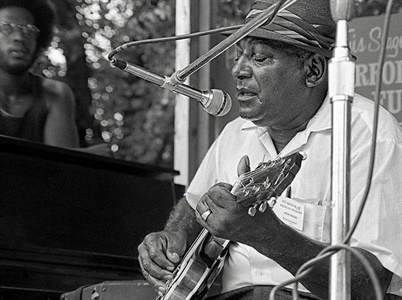
Houston Stackhouse: A Life in the Delta Blues
Introduction
Houston Stackhouse was an American blues guitarist, singer, and musician whose career placed him at the center of the Mississippi Delta blues tradition for several decades. Although he never achieved the commercial fame of Robert Johnson, Sonny Boy Williamson II, or some of the other musicians with whom he associated, Stackhouse was an important link between the acoustic country blues of the prewar South and the increasingly amplified blues of the postwar period.
His significance cannot be measured solely by record sales or the number of recordings issued under his own name. Stackhouse spent much of his career as a working musician, sideman, radio performer, and teacher. He played with some of the most important blues musicians of his generation and helped younger guitarists develop their skills. Robert Nighthawk, Jimmy Rogers, and Sammy Lawhorn were among the musicians associated with his teaching and influence.
Stackhouse remained closely connected to Mississippi and Arkansas throughout most of his life. While many Southern blues musicians migrated to Chicago and other northern cities, he continued performing in juke joints, on radio programs, at dances, and in small venues across the Delta. His life therefore provides an unusually valuable portrait of the regional blues world from the 1930s through the blues revival of the 1960s and 1970s.
Childhood
Houston Stackhouse was born Houston Goff on September 28, 1910, near Wesson, Mississippi. His biological father was Garfield Goff, but Houston was raised by James Wade Stackhouse on the Randall Ford Plantation. He grew up using the Stackhouse surname and reportedly did not learn the full details of his biological parentage until the 1970s, when he attempted to obtain a passport.
Music was part of his environment from an early age. On the plantation, he heard the fiddler Lace Powell, and musically inclined relatives also contributed to his early exposure to Southern folk music. The rural musical culture surrounding Stackhouse was not limited to the blues. Fiddle music, dance tunes, string-band traditions, spiritual music, and emerging blues styles existed side by side.
Before concentrating on the guitar, Stackhouse was exposed to several instruments. Accounts of his musical development mention the violin, harmonica, and mandolin. This broad musical background was typical of many early Southern musicians, who often learned songs and techniques informally rather than through formal instruction.
Around 1925, Stackhouse’s family moved north to Crystal Springs, Mississippi. The move was decisive for his musical development. Crystal Springs and the surrounding area had a rich network of musicians, and Stackhouse encountered performers connected to some of the earliest established traditions of Mississippi blues.
Youth
During his teenage years in Crystal Springs, Stackhouse became increasingly serious about music. Among his strongest influences was Tommy Johnson, one of the major early Mississippi blues singers and guitarists. Stackhouse became deeply familiar with Johnson’s repertoire and performance style. Songs associated with Tommy Johnson would remain central to Stackhouse’s own music decades later.
Stackhouse also absorbed influences from local musicians and from commercial records. Blind Lemon Jefferson, Lonnie Johnson, and Blind Blake were among the recording artists who shaped his musical imagination. Their records demonstrated different approaches to guitar accompaniment, vocal delivery, rhythm, and melodic invention.
The young Stackhouse developed within an oral musical culture. Songs were learned by listening, watching, remembering, and adapting. A blues musician could take an existing song, alter its verses, modify the guitar pattern, or combine elements from several sources. This process would later complicate attempts to describe certain pieces as the exclusive compositions of a single musician.
By the mid-to-late 1930s, Stackhouse had become a professional or semi-professional working musician. He traveled and performed across Mississippi, Arkansas, and Louisiana. His musical circle included members of the Mississippi Sheiks and figures such as Charlie McCoy and Walter Vinson. He also knew and worked in the same regional musical world as Robert Johnson.
One of Stackhouse’s most important relationships was with Robert McCollum, later famous as Robert Nighthawk. The two men were related, and Stackhouse helped teach Nighthawk to play guitar. Nighthawk eventually became one of the great slide guitarists of the blues and achieved greater recognition as a recording artist. Stackhouse’s role in his musical development became an important part of Stackhouse’s historical reputation.
Another enduring musical partnership was with Carey “Ditty” Mason. Such partnerships were essential to Delta musicians, whose careers often depended on networks of friends, relatives, traveling performers, and local venue owners rather than formal management or recording contracts.
Adulthood
In 1946, Robert Nighthawk invited Stackhouse to Helena, Arkansas. Helena was one of the most important blues centers in the Mississippi Delta region. Located along the Mississippi River, the city attracted musicians from Arkansas and Mississippi and supported an active nightlife and radio culture.
Stackhouse joined Nighthawk’s band and performed throughout Arkansas and Mississippi. He also appeared on KFFA radio. Radio was transforming the blues economy in the Delta. Musicians could perform live on the air, promote products for sponsors, and announce their upcoming appearances. A broadcast could create regional recognition and help fill a dance hall or juke joint later that evening.
After separating professionally from Nighthawk in 1947, Stackhouse became associated with musicians working on KFFA’s famous King Biscuit Time. His colleagues included drummer James “Peck” Curtis, guitarist Joe Willie Wilkins, and pianists Pinetop Perkins and Robert Traylor. When Sonny Boy Williamson II returned to the program, Stackhouse became part of a musical circle that was central to postwar Delta blues.
Stackhouse’s years in Helena placed him in contact with an extraordinary number of musicians. He played with or encountered figures including Elmore James, Earl Hooker, Roosevelt Sykes, Jimmy Rogers, and Sammy Lawhorn. Stackhouse helped teach guitar techniques to Rogers and Lawhorn, reinforcing his reputation as a musician valued by other musicians.
Despite his musical activity, Stackhouse did not depend exclusively on the blues for his income. Between 1948 and 1954, he worked during the day at a Chrysler plant in West Memphis while continuing to perform at night. This combination of industrial or manual employment and professional music was common among blues musicians who lacked steady recording royalties or national touring income.
Stackhouse also made a significant decision by remaining in the South. During the Great Migration, many blues musicians moved to Chicago, Detroit, and other northern industrial cities. Chicago, in particular, developed a powerful electric blues industry. Stackhouse remained rooted in the Delta region and continued playing for local audiences through the 1950s and 1960s.
He worked with musicians such as Boyd Gilmore, Houston Boines, Frank Frost, and Baby Face Turner. His career was based on constant participation in the Southern blues circuit rather than a succession of commercially successful records.
In 1965, Sonny Boy Williamson II returned to Helena and again worked with Stackhouse on King Biscuit Time. That May, producer and blues researcher Chris Strachwitz recorded Williamson and his accompanying musicians in performance. Stackhouse participated as an accompanist. Williamson died shortly afterward, and Stackhouse briefly continued his radio work with Robert Nighthawk.
The late 1960s finally brought greater attention from blues researchers and field recordists. In 1967, George Mitchell recorded Stackhouse in Dundee, Mississippi, with Robert Nighthawk and Peck Curtis. The group was identified as the Blues Rhythm Boys. These sessions were historically important, particularly because Nighthawk died only months later.
Blues scholar David Evans also recorded Stackhouse in the Crystal Springs area. Researchers increasingly recognized that Stackhouse possessed a remarkable knowledge of Mississippi blues history and repertoire. He had personally known musicians whose careers reached back to the formative decades of recorded blues.
Around 1970, following the deaths of close musical associates including Carey Mason and Peck Curtis, Stackhouse moved to Memphis, Tennessee. He lived with guitarist Joe Willie Wilkins and Wilkins’s wife, Carrie. By this period, the blues revival had created new audiences for older Southern musicians.
Stackhouse toured with Wilkins, performed with the King Biscuit Boys, and traveled with the Memphis Blues Caravan. He appeared at blues festivals and began performing for audiences interested in the historical traditions of Delta and country blues.
In February 1972, Stackhouse made an important studio recording in Silver Spring, Maryland. The material was later issued as Cryin’ Won’t Help You. The sessions preserved his mature voice and guitar style and included songs representing the broad repertoire he had accumulated over decades.
In 1976, Stackhouse made his only major overseas trip, traveling to Vienna, Austria. The journey demonstrated the remarkable international growth of interest in American blues. A musician who had spent most of his career playing small Southern venues was now performing for European blues enthusiasts.
After the European trip, Stackhouse largely withdrew from extensive musical activity. He remained connected to the places and traditions that had shaped his life, eventually returning to Arkansas.
Major Compositions
Discussing Houston Stackhouse’s “major compositions” requires some qualification. The Delta blues tradition in which he developed was strongly based on oral transmission. Musicians frequently learned songs from one another, changed lyrics, borrowed guitar figures, and created individual versions of older material. Consequently, many songs associated with Stackhouse were interpretations or adaptations rather than compositions in the modern singer-songwriter sense.
One of the pieces most closely associated with his recorded legacy is “Big Road Blues.” The song originated with Tommy Johnson, whose music profoundly influenced Stackhouse. Stackhouse’s performances of the piece demonstrate his role as a carrier of the early Mississippi blues tradition. Rather than simply copying an old record, he preserved the song as part of a living performance repertoire.
“Cool Water Blues” was another important part of his Tommy Johnson-derived repertoire. Stackhouse’s familiarity with Johnson’s music gave later listeners and researchers insight into how early blues songs survived outside the commercial recording industry.
“Big Fat Mama Blues” also appeared in Stackhouse’s recorded repertoire. His performances of such material reveal the relationship between early Delta blues and the later generation of musicians who continued playing these songs in juke joints and informal settings.
“Cryin’ Won’t Help Me Stay,” also associated with titles such as “Cryin’ Won’t Help You,” became particularly important in Stackhouse’s later recorded legacy. The title was used for the album Cryin’ Won’t Help You, which preserved his 1972 studio recordings.
His recorded repertoire also included “Kind Hearted Woman Blues,” “Bricks in My Pillow,” “Bye Bye Blues,” “Sweet Black Angel Blues,” and “Pony Blues.” Many of these songs were connected to earlier blues musicians or to widely shared blues traditions. Stackhouse’s importance lies in the distinctive way he interpreted and transmitted this material.
For this reason, Stackhouse should be understood less as a prolific commercial songwriter and more as a repertory musician and tradition bearer. His music preserved songs, guitar patterns, and performance practices that linked the blues of the 1920s and 1930s with the blues revival era.
His performances also illustrate a fundamental characteristic of traditional blues composition: a song was not necessarily a fixed object. Lyrics could change from one performance to another. Verses could migrate between songs. Guitar patterns could be adapted to different texts. Stackhouse’s repertoire reflected this fluid musical culture.
Death
In his later years, Houston Stackhouse returned to Helena, Arkansas. By then, he had outlived many of the musicians with whom he had worked during the most active years of his career. Robert Johnson, Tommy Johnson, Sonny Boy Williamson II, Robert Nighthawk, Carey Mason, and Peck Curtis had all died before him.
Houston Stackhouse died on September 23, 1980, at Helena Hospital in Helena, Arkansas. He was sixty-nine years old and only five days away from his seventieth birthday. He was survived by a son, Houston Stackhouse Jr.
At the time of his death, Stackhouse was still far less famous than many of the musicians whose paths had crossed his own. His relatively small discography limited his visibility among general blues audiences. Much of his most important work had occurred in juke joints, radio studios, informal teaching relationships, and regional performances that left little documentary evidence.
His reputation grew after his death. Recordings were reissued, and collections such as Cryin’ Won’t Help You and Big Road Blues made his music more accessible. Historians increasingly emphasized his importance as a mentor and as a central participant in the Delta blues community.
In 2012, Stackhouse was honored with a Mississippi Blues Trail marker in Wesson. His name was also commemorated through an acoustic stage associated with the Arkansas blues festival tradition. These honors reflected a broader reassessment of blues history that recognized the importance of regional musicians who had influenced their peers without becoming major recording stars.
Conclusion
Houston Stackhouse’s life challenges the idea that musical importance can be measured only by fame, record sales, or a large catalog of original compositions. He spent decades at the center of the Southern blues world while remaining relatively unknown outside it.
His career connected several generations of blues history. As a young musician, he absorbed the influence of Tommy Johnson and the early Mississippi tradition. During the 1930s, he moved among musicians connected to Robert Johnson and the Mississippi Sheiks. In the 1940s, he worked with Robert Nighthawk and became part of Helena’s radio blues culture. Through King Biscuit Time, he participated in one of the most influential regional broadcasting traditions in blues history.
As a teacher and mentor, Stackhouse transmitted guitar knowledge to musicians who would achieve greater national recognition. As a working performer, he preserved a repertoire rooted in the early Delta blues. As an older musician, he became a valuable source for researchers seeking to understand how the blues was actually learned, played, and circulated among Southern musicians.
Stackhouse was not merely a secondary figure standing beside more famous bluesmen. He was part of the musical network that made their world possible. His story demonstrates that the history of the blues was created not only in recording studios but also on plantations, at country dances, in juke joints, on local radio stations, in automobiles traveling from town to town, and through informal lessons between musicians.
For much of his life, Houston Stackhouse remained close to the Mississippi Delta and its musical communities. That regional loyalty limited his commercial opportunities, but it also made him an exceptional witness to the evolution of Southern blues. His career stretched from the acoustic traditions of the early twentieth century to the international blues revival of the 1970s.
Today, Houston Stackhouse is remembered as a mentor, guitarist, singer, radio performer, and keeper of the Delta blues tradition. His recordings preserve only a portion of his musical life, but his influence can also be heard indirectly through the musicians he taught and the repertoire he helped carry forward. His legacy is that of a bluesman’s bluesman: respected by his peers, deeply rooted in his musical culture, and essential to understanding the living history of the Delta blues.
Comments are closed