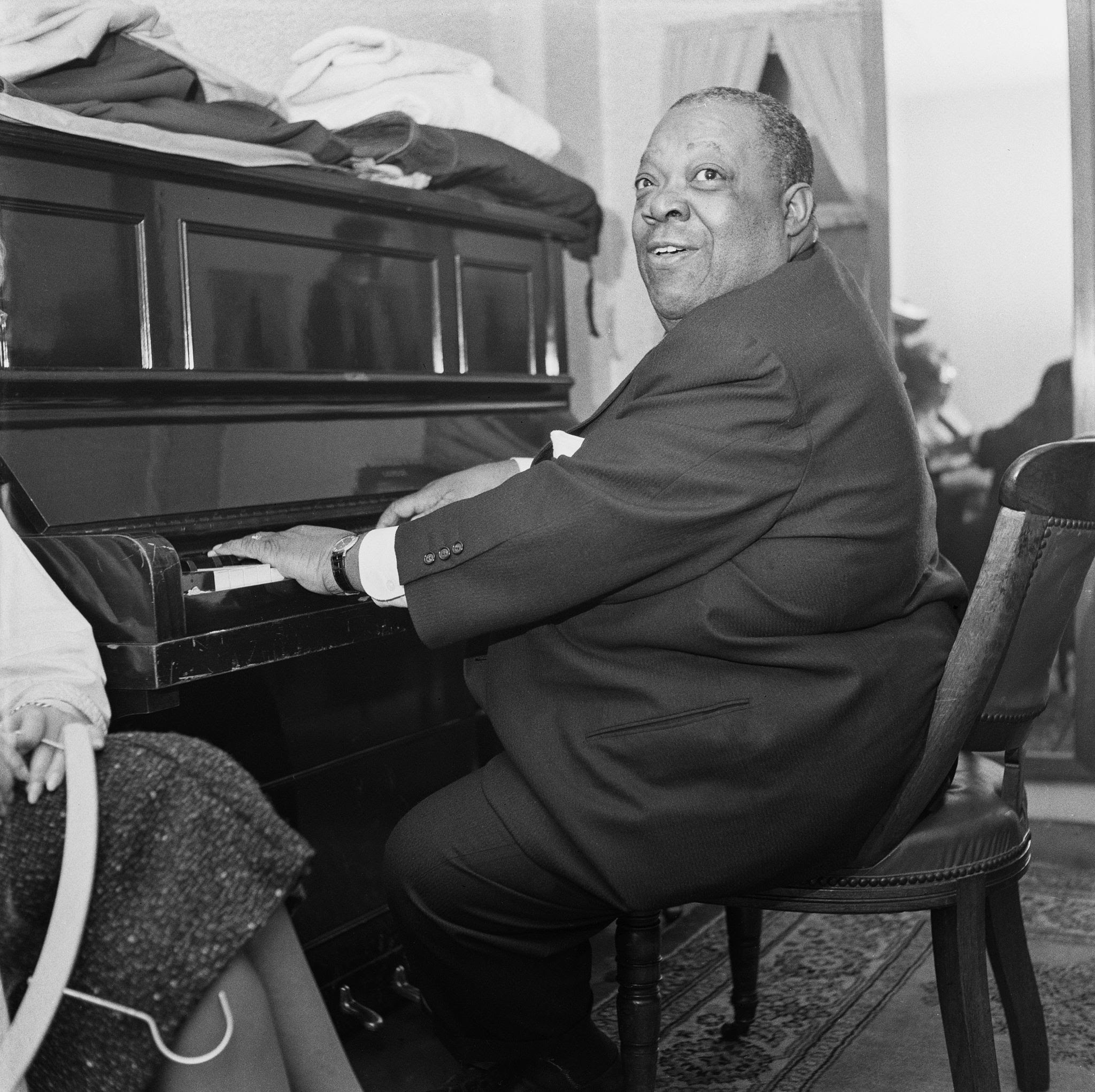
Jimmy Rushing: A Biography
Introduction
Jimmy Rushing was one of the most distinctive voices in twentieth-century American jazz and blues. Known for his powerful delivery, warm tone, commanding presence, and remarkable rhythmic sense, he became one of the defining vocalists of the swing era. Although he was often described as a blues shouter, that label only partially captured his artistry. Rushing could project his voice over a large orchestra, but he also possessed subtle phrasing, humor, emotional depth, and an instinctive ability to swing.
He achieved his greatest fame as the featured vocalist of the Count Basie Orchestra during the 1930s and 1940s. In that role, he helped transform Kansas City blues traditions into nationally recognized swing music. His recordings with Basie became classics, and his later solo career demonstrated that he could remain compelling long after the big-band era had declined.
Throughout his life, Rushing remained closely associated with blues, jazz, and the musical culture of Kansas City. His voice connected the earthy directness of the blues with the polished arrangements and rhythmic energy of swing. For generations of listeners and musicians, Jimmy Rushing represented a bridge between traditional blues singing and modern jazz performance.
Childhood
James Andrew Rushing, later known professionally as Jimmy Rushing, was born in Oklahoma City, Oklahoma, on August 26, 1901. He grew up in a musical household. His father, Andrew Rushing, played tuba in local bands, and music was an important part of the family environment.
As a boy, Rushing showed an early interest in instruments as well as singing. He learned to play the violin by ear and later studied piano. His parents reportedly worried that the piano might lead him toward the nightlife associated with clubs and entertainment venues, but his interest in music remained strong. He also studied music at Douglass High School in Oklahoma City.
The musical world surrounding Rushing’s childhood included church music, blues, ragtime, brass bands, and the developing sounds of jazz. Oklahoma City was connected culturally and geographically to the Southwest and Kansas City, two regions that would play a major role in the rise of swing and blues-based jazz. Rushing absorbed these influences early, developing an understanding of rhythm and melody that later became central to his style.
His childhood did not immediately lead to fame, but it gave him the musical foundation that would shape his career. The ability to hear music intuitively, to sing with force, and to understand instrumental accompaniment would later distinguish him from many other vocalists.
Youth
During his youth, Jimmy Rushing began to pursue music professionally. He performed with local groups and gradually established himself as a singer capable of handling blues material, popular songs, and jazz-oriented arrangements. His voice was naturally large and resonant, allowing him to perform without relying heavily on amplification.
In the 1920s, Rushing became involved with bands in the Midwest, an area that was becoming increasingly important to the development of jazz. The region’s musical culture encouraged improvisation, blues feeling, powerful rhythm sections, and informal jam-session traditions. These qualities would later become central to the sound of the Count Basie Orchestra.
Rushing performed with Walter Page’s Blue Devils, an influential Kansas City territory band. The Blue Devils included several musicians who would later become important figures in the Count Basie Orchestra and the larger swing movement. Working with this ensemble gave Rushing valuable experience in performing with skilled instrumentalists and in developing his ability to interact with a full band.
His years in the Midwest also helped him refine his vocal identity. He learned how to balance the raw emotional power of blues singing with the precision required by jazz ensembles. Rushing was not simply a singer who delivered lyrics; he became an active participant in the rhythmic conversation of the band.
By the early 1930s, he had developed into a mature performer with a recognizable sound. His reputation as a forceful blues vocalist was growing, and his connection with Kansas City musicians placed him near the center of an important musical movement.
Adulthood
Jimmy Rushing’s adult career reached its greatest heights when he joined Count Basie’s orchestra. He became one of the band’s most important vocalists and remained closely associated with Basie from 1935 until 1950. During this period, the Count Basie Orchestra became one of the leading big bands in American music.
The Basie orchestra was known for its relaxed but powerful swing, its strong rhythm section, and its ability to turn blues material into sophisticated jazz arrangements. Rushing fit naturally into this environment. His voice had enough power to rise above the orchestra, yet he also understood how to phrase lyrics in a way that complemented the band’s rhythmic pulse.
Rushing became known as “Mr. Five by Five,” a nickname referring affectionately to his compact physical build. Onstage, however, his presence was anything but small. His broad, expressive voice could fill a theater, and his performances often combined humor, confidence, drama, and emotional intensity.
During his years with Basie, Rushing appeared on many important recordings. He helped establish the sound of blues-oriented big-band singing and influenced later performers who sought to combine jazz phrasing with blues feeling. His work was particularly significant because he could perform with the strength of a traditional blues singer while maintaining the rhythmic flexibility needed for swing.
After leaving the Count Basie Orchestra in 1950, Rushing continued as a solo performer. Although the popularity of large swing bands had declined, he remained active and respected. He recorded albums under his own name, performed in clubs and festivals, and worked with prominent jazz musicians.
His solo career allowed him to explore a broader range of material. He recorded blues, jazz standards, and older songs from the 1920s and 1930s. He also appeared at major jazz events, including the Newport Jazz Festival. His performances demonstrated that he had retained his vocal strength and musical imagination.
In later years, Rushing collaborated with artists from different generations. He performed with musicians who admired his connection to the earlier jazz and blues traditions, and he continued to bring authority to every song he sang. Even as musical styles changed, he remained relevant because his vocal approach was based on strong rhythm, emotional honesty, and an unmistakable personal sound.
Major Compositions
Although Jimmy Rushing was best known as a singer and interpreter rather than exclusively as a songwriter, he contributed to and became closely identified with several important blues and jazz numbers.
One of his best-known songs was “Sent for You Yesterday (and Here You Come Today).” The composition became a major success for the Count Basie Orchestra and showcased Rushing’s ability to combine blues storytelling with swinging big-band accompaniment. Rushing contributed lyrics to the song, while Count Basie and Eddie Durham were associated with its musical composition.
Another major song connected to Rushing was “Goin’ to Chicago Blues.” This number became one of his signature performances and remained associated with him throughout his career. Its lyrics and relaxed blues structure gave Rushing room to display his storytelling ability, vocal authority, and deep connection to Kansas City-style jazz.
Rushing was also strongly associated with “Every Day I Have the Blues,” a blues standard that he recorded later in his career. Although he did not compose the song, his interpretation helped introduce it to audiences who valued his blend of jazz and blues expression. His version demonstrated that he could bring freshness and individuality to material written by others.
Other significant recordings included “Good Morning Blues,” “Boogie Woogie,” “I Left My Baby,” “Blues in the Dark,” and “Baby, Don’t Tell on Me.” These songs reflected the range of Rushing’s talent. Some were humorous, some were romantic, some were dramatic, and others celebrated the rhythmic energy of swing music.
Rushing’s greatest achievement was not simply writing or recording individual songs. It was the way he transformed material through performance. His voice made songs memorable because he understood how to shape a phrase, emphasize a lyric, and communicate directly with an audience.
Death
Jimmy Rushing died on June 8, 1972, in New York City. His death marked the loss of one of the major vocal figures of the swing era and one of the most important interpreters of blues within jazz.
By the time of his death, Rushing had spent decades performing and recording. He had worked with Count Basie, participated in the development of big-band swing, and maintained an active career after the decline of the large orchestras that had made him famous.
His passing was recognized by members of the jazz community as the loss of a musician whose style could not easily be replaced. Rushing had been part of a generation that helped define the sound of American popular music during the 1930s and 1940s. His voice carried the energy of Kansas City blues, the discipline of swing, and the personality of a great entertainer.
Conclusion
Jimmy Rushing remains an essential figure in the history of American jazz and blues. His career connected several important musical traditions: Oklahoma and Kansas City blues, big-band swing, jazz improvisation, and popular vocal performance.
As the featured vocalist with Count Basie, he helped create some of the most memorable recordings of the swing era. As a solo artist, he proved that his artistry extended far beyond one orchestra or one musical period. He could sing blues with force and humor, interpret jazz standards with elegance, and communicate with audiences through the distinctive character of his voice.
Rushing’s influence can be heard in later blues and jazz singers who combined vocal power with rhythmic sophistication. He demonstrated that a singer could function as a full member of a jazz ensemble, responding to instrumentalists, shaping the rhythm, and adding emotional meaning to every performance.
More than fifty years after his death, Jimmy Rushing continues to be remembered as a master of blues-inflected jazz singing. His recordings preserve the sound of an artist who could be both commanding and subtle, both humorous and deeply expressive. His legacy remains an important part of the story of American music.
Comments are closed