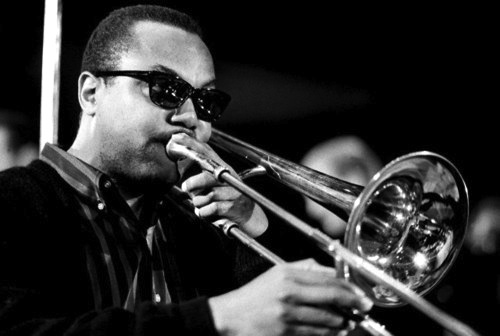
J.J. Johnson: A Complete Biography
Introduction
James Louis “J.J.” Johnson (January 22, 1924 – February 4, 2001) was one of the most influential jazz musicians of the twentieth century. A virtuoso trombonist, composer, and arranger, he transformed the role of the trombone in modern jazz by proving that the instrument could perform the rapid, sophisticated melodic lines associated with bebop. Before Johnson, many musicians believed that the slide trombone was too cumbersome for the fast tempos and harmonic complexity of the new jazz language pioneered by Charlie Parker and Dizzy Gillespie. Johnson permanently changed that perception.
Over a career spanning more than five decades, Johnson performed with many of the greatest names in jazz, including Count Basie, Benny Carter, Charlie Parker, Miles Davis, Dizzy Gillespie, Oscar Pettiford, and Kai Winding. Beyond his extraordinary achievements as a performer, he became a respected composer of concert works, orchestral pieces, film scores, and television music. His influence on generations of trombonists is immeasurable, and he remains widely regarded as one of the greatest jazz trombonists in history.
Childhood
J.J. Johnson was born James Louis Johnson in Indianapolis, Indiana, on January 22, 1924. He grew up in a supportive family that encouraged his musical interests from an early age. His first formal musical training came through piano lessons, which he began around the age of nine under the guidance of his church organist. This early education gave him a solid understanding of harmony and musical structure that later became evident in both his improvisations and compositions.
At the age of fourteen, Johnson switched his attention to the trombone. Although he began the instrument later than many professional musicians, he quickly demonstrated remarkable talent and discipline. He attended Crispus Attucks High School, where he developed rapidly as a performer while listening to recordings of jazz innovators. Instead of modeling his playing after traditional trombonists, Johnson drew inspiration from saxophonists such as Lester Young, whose smooth phrasing and lyrical approach profoundly influenced his musical thinking.
His determination to master the technical limitations of the trombone laid the foundation for the revolutionary playing style that would later define his career.
Youth
Johnson began his professional career while still a teenager. During the early 1940s, he performed with regional bands led by Clarence Love and Snookum Russell. It was during his time with Russell that he met trumpeter Fats Navarro, who introduced him to the rapidly developing bebop movement.
In 1942, Johnson joined Benny Carter’s orchestra, one of the finest big bands of the era. His first recordings appeared with Carter in 1943, and fellow musicians quickly recognized his exceptional technical ability. Unlike previous jazz trombonists, Johnson executed rapid bebop lines with remarkable clarity, smoothness, and precision.
After leaving Carter’s orchestra, Johnson performed with Count Basie from 1945 to 1946. During this period he also worked alongside Charlie Parker, Dizzy Gillespie, and other leading bebop innovators. These collaborations established him as one of the central figures in modern jazz and demonstrated that the trombone could become a fully expressive bebop instrument.
By the end of the 1940s, Johnson had become one of the most respected young musicians in jazz, admired not only for his virtuosity but also for his mature musical ideas and elegant improvisations.
Adulthood
The 1950s marked the beginning of Johnson’s greatest artistic achievements. Although he briefly left full-time music between 1952 and 1954 to work as a blueprint reader because of financial difficulties, he soon returned with renewed determination.
One of the defining moments of his career came when he formed the celebrated Jay and Kai Quintet with fellow trombonist Kai Winding. The group’s innovative two-trombone format challenged conventional jazz instrumentation and became one of the most successful ensembles of the decade. Their recordings demonstrated the versatility, richness, and expressive possibilities of the trombone.
Johnson also established himself as a distinguished composer. His orchestral works, including El Camino Real, Perceptions, and Sketch for Trombone and Orchestra, combined jazz improvisation with classical forms. These ambitious compositions earned commissions from major festivals and prominent musicians, including Dizzy Gillespie.
Throughout the 1960s, Johnson continued to perform with Miles Davis and numerous other jazz legends while leading his own ensembles. In 1970 he relocated to California, where he entered a new phase of his career as a composer for film and television. His music appeared in numerous productions, including Mayberry R.F.D., That Girl, The Mod Squad, The Six Million Dollar Man, and Starsky & Hutch.
Although he reduced his performing schedule during these years, Johnson remained highly respected throughout the jazz world. Even while concentrating on composition, he continued to receive awards and consistently ranked among the leading trombonists in jazz polls.
In the late 1980s, Johnson returned to Indianapolis and resumed recording, touring, and composing. His later albums demonstrated that his technical mastery and creative imagination remained undiminished. In 1996, he received one of American jazz’s highest honors when he was named an NEA Jazz Master, recognizing his lifelong contribution to the art form.
Major Compositions
Although Johnson is best remembered as a performer, he was also an accomplished composer whose works became an important part of the jazz repertoire.
Among his best-known compositions are:
- Lament – Perhaps Johnson’s most famous composition, this lyrical ballad has become a jazz standard and is frequently performed by trombonists and other instrumentalists.
- Wee Dot – A sophisticated bebop composition that showcases Johnson’s melodic creativity and harmonic imagination.
- Enigma – A complex modern jazz work admired for its inventive structure and memorable themes.
- El Camino Real – A large-scale composition commissioned by the Monterey Jazz Festival, combining orchestral writing with jazz elements.
- Perceptions – A major orchestral suite written for Dizzy Gillespie and recorded with a large ensemble.
- Sketch for Trombone and Orchestra – An ambitious work demonstrating Johnson’s ability to integrate classical orchestration with jazz language.
- Poem for Brass – One of his earliest extended compositions, reflecting his growing interest in concert music.
Johnson also composed numerous arrangements, film scores, television soundtracks, and original jazz works that expanded the artistic possibilities of jazz composition during the second half of the twentieth century.
Death
J.J. Johnson died on February 4, 2001, at his home in Indianapolis, Indiana, at the age of seventy-seven. His death was ruled a suicide following a prolonged struggle with serious health problems and the emotional difficulties associated with them.
The news deeply saddened the international jazz community. Musicians, critics, and historians paid tribute not only to Johnson’s extraordinary technical achievements but also to his dignity, professionalism, and lifelong commitment to artistic excellence.
Today, his recordings continue to inspire trombonists and jazz musicians around the world. His innovations permanently altered the role of the trombone in jazz, making him one of the instrument’s most influential figures.
Conclusion
J.J. Johnson occupies a unique position in jazz history. Through extraordinary technical skill, musical intelligence, and relentless dedication, he accomplished what many had considered impossible: he transformed the trombone into a leading voice of bebop and modern jazz.
His career encompassed exceptional performances, groundbreaking recordings, innovative compositions, and successful work in film and television. Whether performing alongside legendary jazz artists or composing ambitious orchestral works, Johnson consistently demonstrated remarkable creativity and professionalism.
More than two decades after his death, his influence remains evident in virtually every modern jazz trombonist. His recordings, compositions, and artistic vision continue to educate and inspire musicians, ensuring that J.J. Johnson’s legacy will endure as one of the greatest innovators in the history of American jazz.
Comments are closed