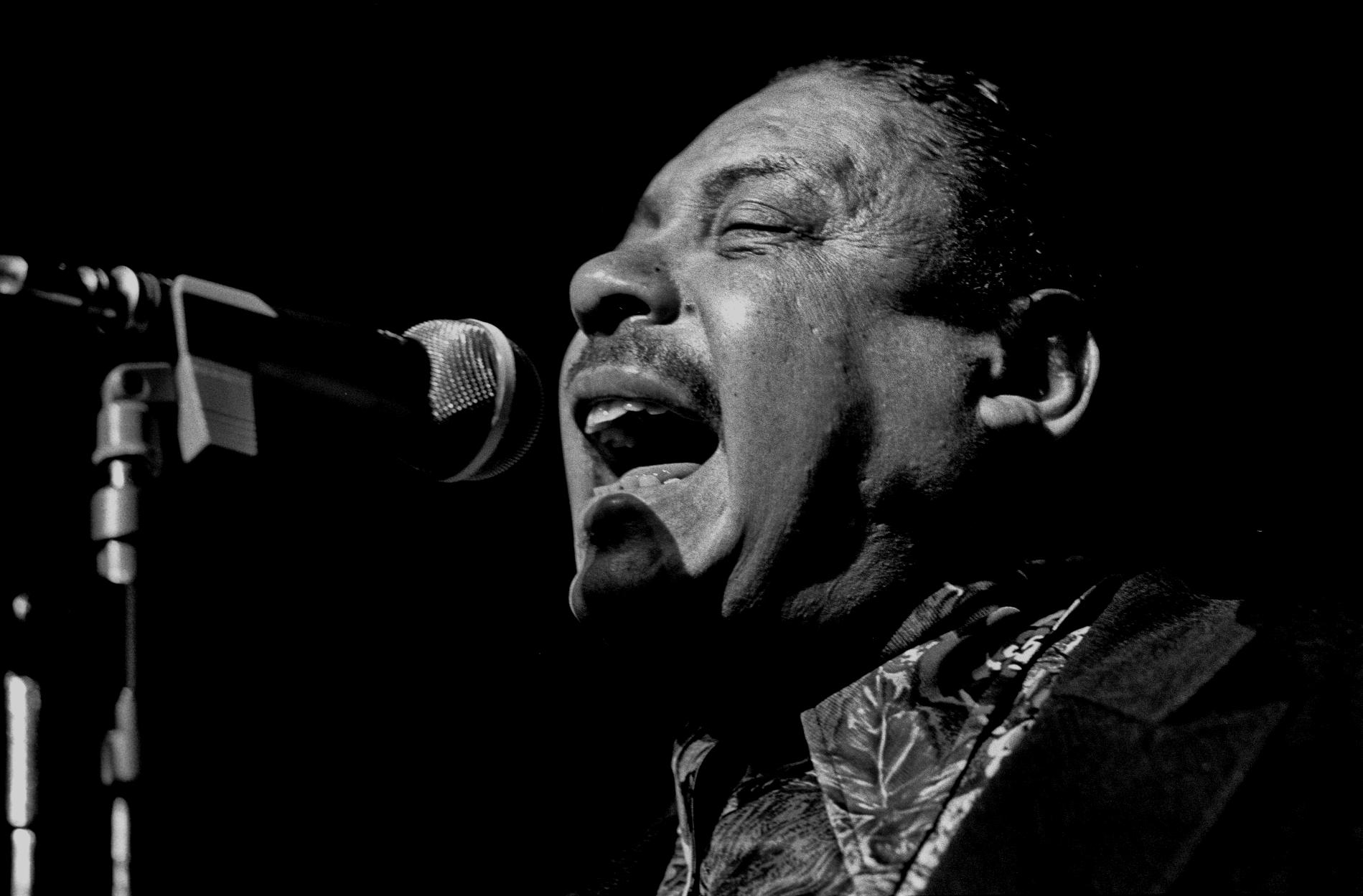
Big Joe Turner – A Complete Biography
Introduction
Joseph Vernon “Big Joe” Turner Jr. (May 18, 1911 – November 24, 1985) was a foundational American blues singer whose powerful, chest-driven voice and commanding stage presence helped bridge prewar blues and boogie-woogie with postwar rhythm & blues and the earliest strains of rock and roll. Known as the “Boss of the Blues,” Turner’s career spanned more than five decades: he was a nightclub fixture in Kansas City in the 1920s and 1930s, a popular recording artist in the 1940s and 1950s, and a respected elder statesman of American roots music through the 1970s and into the 1980s. His recordings—both solo and in duet with pianists such as Pete Johnson—produced enduring standards and left an unmistakable imprint on later rhythm-and-blues and rock artists.
Childhood
Joseph Vernon Turner Jr. was born in Kansas City, Missouri, into an environment that would become one of the most fertile American musical incubators of the 20th century. His father died when he was a small child, and Turner’s early years were shaped by church music, street performance, and the bustling nightlife of Kansas City. He sang in church choirs and on street corners to help support the family; those early experiences contributed to his technique—an emphatic, projection-rich style that allowed him to be heard over loud band arrangements and boogie-woogie piano. Formal schooling ended early: Turner left school as a teenager and entered the workforce in Kansas City’s entertainment economy, first as a cook and later as a singing bartender. Those jobs placed him in direct contact with the city’s musicians and clubgoing public, and they served as on-the-job training in phrasing, showmanship, and repertoire.
Youth
As a young man Turner performed regularly in Kansas City nightclubs and small venues where jazz, swing, and the rawer forms of blues and boogie-woogie circulated freely. It was in this milieu that he developed an important musical partnership with pianist Pete Johnson. The pair became a well-known act, combining Johnson’s percussive, rolling piano with Turner’s booming vocal delivery. Their collaboration brought Turner to wider attention: a high-profile appearance at the landmark “From Spirituals to Swing” Carnegie Hall concert in 1938 introduced the duo to national audiences and to influential producers and critics. That period also yielded the duo’s seminal recording “Roll ’Em Pete” (recorded in late 1938), a hard-driving number that stands as one of the great early examples of boogie-woogie and a clear precursor to many elements that later defined rock and roll.
Adulthood and Career
Turner’s adult career is characterized by adaptability and reinvention. After his early success with Pete Johnson in the late 1930s and early 1940s, Turner moved between live performance circuits and studio work. He recorded for a number of labels and worked in both small-group jump-blues settings and larger swing contexts. In the late 1940s and early 1950s, as rhythm and blues gained commercial traction, Turner became a major recording artist: his clear, forceful voice lent itself to the jump blues style that translated well to postwar record audiences and jukebox play. Turner’s repertoire in this era included rollicking up-tempo numbers, humorous storytelling songs, and slower blues that displayed his interpretive range.
The early 1950s produced several of Turner’s career-defining hits. Notably, “Honey Hush” and “Flip, Flop and Fly” (among others) placed him squarely within the R&B hits of the period. In 1954 Turner recorded “Shake, Rattle and Roll,” a Jesse Stone composition that combined suggestive lyrics, a rollicking backbeat, and Turner’s shouting delivery. The record achieved broad popularity and, in its various cover versions, became emblematic of the musical exchange that helped shape early rock and roll. Though some white cover versions by other artists reached larger pop charts at the time, Turner’s originals retained credibility and influence among musicians and later historians who trace rock’s roots to R&B and jump-blues performers such as Turner.
Through the 1960s and 1970s Turner remained active as a performer; he toured, recorded, and appeared at clubs, jazz festivals, and concert halls. During this later phase he was often cast as a venerable elder of the blues, a performer with first-hand links to the prewar roots of American popular music. Musically, he continued to draw on his Kansas City upbringing and his early collaborations, and he willingly revisited both boogie-woogie and jump-blues material for new audiences. His stage persona—tall, rotund, and vocally commanding—made him an audience favorite and an attractive booking for promoters seeking authenticity and showmanship.
Major Compositions and Recordings
Big Joe Turner’s recorded legacy is organized around several categories: early boogie-woogie collaborations, postwar jump-blues hits, and later career reinterpretations. Key recordings that illustrate his contribution include:
- “Roll ’Em Pete” (with Pete Johnson, 1938): An early studio record that captures the raw energy of boogie-woogie piano and Turner’s vigorous vocal shouts; it is often cited as an important antecedent to rhythm-and-blues and rock and roll.
- “Honey Hush” (early 1950s): One of Turner’s R&B chart successes that showcased his ability to combine humor and sexual innuendo with a propulsive groove.
- “Flip, Flop and Fly” and “TV Mama”: Jump-blues numbers that were staples of his live shows and of jukebox playlists.
- “Shake, Rattle and Roll” (1954): Written by Jesse Stone (credited under a pen name) and popularized by Turner; the recording’s rollicking rhythm and suggestive lyrics made it a touchstone in the transition from R&B to rock and roll.
- Additional standards and live cuts: Over decades of performance Turner recorded numerous other tracks—both originals and traditional material—that showcased his range from raucous shouts to smoldering blues.
Collectively, these recordings demonstrate Turner’s role as both an interpreter and transmitter of styles: he absorbed urban blues, gospel, and boogie-woogie and refashioned them into records that appealed to postwar audiences while influencing younger musicians.
Death
Joseph Vernon “Big Joe” Turner Jr. died on November 24, 1985, in Inglewood, California. He was 74 years old. In the years leading up to his death he had been recognized by peers, historians, and institutions for his foundational role in American popular music; his passing was widely noted in music press and among the blues and jazz communities. Posthumous honors have affirmed his influence: retrospective recognition, hall-of-fame inductions, reissues, and historical assessments all place Turner among the most consequential performers in the lineage linking blues, R&B, and rock.
Conclusion
Big Joe Turner’s career resists tidy categorization because it spans stylistic eras and cultural shifts. He began singing in the Kansas City clubs of the 1920s and 1930s, helped articulate boogie-woogie and jump-blues idioms with his colleagues, and recorded some of the most widely recognized proto–rock-and-roll numbers of the 1950s. His voice—huge, resonant, and suited to both shouting and narrative blues—made him a natural frontman for an array of musical contexts, and his recordings and live performances influenced generations of singers and bandleaders. Today, Turner’s name appears in histories of blues and early rock precisely because his work exemplified the crosscurrents of African American popular music in the mid-20th century: he was at once a product of his local scene and a national figure whose sound helped shape modern American music.
Comments are closed