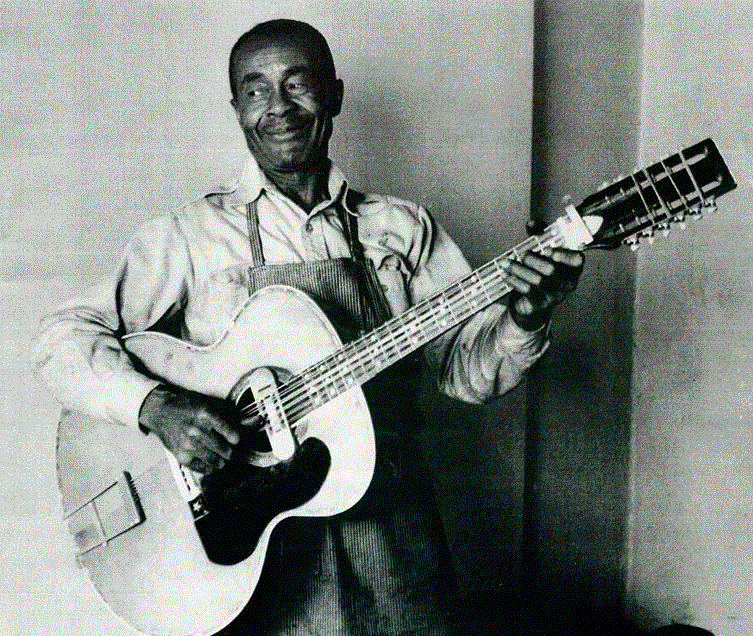
Jesse Fuller: A Complete Biography
Introduction
Jesse Fuller (March 12, 1896 – January 29, 1976) was one of the most distinctive figures in American blues and folk music. A gifted singer, songwriter, guitarist, harmonica player, and inventor, he became famous as a true one-man band, performing alone while simultaneously playing multiple instruments. His energetic performances, warm personality, and remarkable musicianship earned him recognition during the American folk revival of the 1950s and 1960s.
Fuller is best remembered for writing “San Francisco Bay Blues,” a song that became an American folk standard after being recorded by numerous artists, including Peter, Paul and Mary, Bob Dylan, Eric Clapton, and many others. His influence extended well beyond blues, inspiring generations of folk, rock, and street musicians through both his performances and his innovative approach to solo entertainment.
Childhood
Jesse Fuller was born in Jonesboro, Georgia, near Atlanta, on March 12, 1896. His childhood was marked by poverty, instability, and hardship. His father was absent from his life, and after his mother’s death during his early years, Fuller was raised by foster parents who treated him harshly. The difficult circumstances forced him to become self-reliant from a very young age.
By the age of nine, he was already working to support himself, tending livestock and performing manual labor. He later found employment in factories, rock quarries, sawmills, and railroad crews. Despite these hardships, music became an important refuge. Around the age of ten, he began learning guitar by observing local musicians and building simple homemade instruments. He absorbed a wide variety of musical traditions, including blues, spirituals, work songs, ragtime, minstrel tunes, and popular folk melodies.
These early experiences shaped the broad musical vocabulary that later distinguished him from many of his contemporaries. Rather than specializing exclusively in blues, Fuller developed into what musicians often call a “songster”—a performer with an exceptionally diverse repertoire.
Youth
As a teenager and young adult, Fuller traveled extensively throughout the American South seeking employment. He continued performing music informally while working a wide variety of jobs, including railroad laborer, farm worker, factory employee, shoeshiner, and construction worker.
Eventually, he migrated westward, spending time in Los Angeles during the silent film era. While living there, he worked as a shoe shiner near Hollywood studios and occasionally appeared as an extra in silent motion pictures, including The Thief of Bagdad. These experiences exposed him to diverse audiences and reinforced his desire to entertain professionally.
In 1929, Fuller settled permanently in Oakland, California. Like many Americans during the Great Depression, he continued to rely on manual labor to support himself. He worked for the Southern Pacific Railroad and held numerous other jobs while continuing to perform music whenever opportunities arose.
Although music remained largely a part-time pursuit during these years, Fuller steadily refined his unique performance style and expanded his repertoire, preparing for the professional career that would emerge later in life.
Adulthood
Unlike many professional musicians, Jesse Fuller did not achieve widespread recognition until relatively late in life. During the early 1950s, after decades of balancing music with manual labor, he decided to devote himself seriously to performing.
His greatest innovation was his development of the fotdella, a foot-operated bass instrument that allowed him to accompany himself while simultaneously playing twelve-string guitar, harmonica, kazoo, and percussion. The instrument enabled Fuller to create the sound of an entire band without additional musicians, making him one of America’s most remarkable one-man performers.
His energetic live performances became popular throughout the San Francisco Bay Area during the folk revival. Television appearances, club performances, and recordings introduced him to a national audience. In 1958, he released Jazz, Folk Songs, Spirituals & Blues, the first of several influential albums.
Fuller’s reputation expanded internationally during the 1960s. He toured Europe, appeared at major folk festivals, and became admired by younger musicians. Bob Dylan frequently performed Fuller’s songs, while the Grateful Dead incorporated several of his compositions into their repertoire. British performer Don Partridge later credited Fuller as the inspiration for his own successful one-man-band career.
Although he achieved fame relatively late, Fuller remained an active performer into his late seventies, maintaining the cheerful stage presence and musical versatility that defined his career.
Major Compositions
Jesse Fuller’s songwriting reflected his experiences traveling across America, working difficult jobs, and entertaining audiences with humor and optimism. His music blended blues, folk, ragtime, railroad songs, and popular traditions.
His most celebrated composition is “San Francisco Bay Blues,” written in the mid-1950s. The song quickly became one of the best-known standards of the folk revival. Its memorable melody, relaxed rhythm, and vivid lyrics encouraged countless interpretations by artists from a variety of musical genres.
Other notable songs include:
- Beat It on Down the Line – later popularized by the Grateful Dead.
- The Monkey and the Engineer – a humorous railroad ballad that became another Grateful Dead favorite.
- Crazy About a Woman
- Lining Up the Track
- Working on the Railroad
- Move On Down the Line
Unlike many blues musicians whose work focused on sorrow and hardship, Fuller often emphasized humor, storytelling, travel, and everyday life. His broad repertoire demonstrated the traditions of the American songster, combining blues with folk songs, spirituals, work songs, and popular music.
Today, many of his recordings are regarded as valuable examples of mid-twentieth-century American folk and blues traditions.
Death
Jesse Fuller died of heart disease on January 29, 1976, in Oakland, California, at the age of seventy-nine. He was buried at Evergreen Cemetery in Oakland.
Following his death, his historical significance continued to grow. His homemade fotdella and one of his guitars were preserved by the Smithsonian Institution as important artifacts documenting American folk music history. His recordings continue to be reissued, and his compositions remain part of the repertoires of blues, folk, and Americana musicians around the world.
His influence can also be seen in later one-man-band performers who adopted similar multi-instrumental performance techniques, demonstrating the lasting impact of his creativity and innovation.
Conclusion
Jesse Fuller occupies a unique place in American musical history. Rising from an impoverished childhood marked by hardship and manual labor, he transformed himself into one of the most original entertainers of the twentieth century. His ability to perform as an entire band by himself, combined with his inventive musicianship and warm stage presence, distinguished him from nearly every other blues performer of his era.
While “San Francisco Bay Blues” remains his best-known achievement, Fuller’s legacy extends far beyond a single composition. He helped preserve the traditions of the American songster, demonstrated extraordinary technical ingenuity through the invention of the fotdella, and inspired generations of musicians across blues, folk, rock, and popular music.
Today, Jesse Fuller is remembered not only as an exceptional blues musician but also as an innovator whose creativity, resilience, and joyful performances continue to influence artists and audiences worldwide.
Comments are closed